RAFFAELLO SANZIO

Raphael in Rome
When Raphael arrived in Rome in 1508, summoned by Pope Julius II, he was already an established artist thanks to the experience he had gained in Urbino, Perugia and Florence. The papal capital, the political and cultural centre of the Renaissance, offered him the opportunity to engage with the greatest artists of the time, including Michelangelo and Bramante.
In the Vatican Rooms, Raphael created frescoes of extraordinary power and harmony, such as the famous School of Athens, which became a manifesto of humanistic culture. Rome turned into an inexhaustible laboratory for him, where architecture, painting and classical antiquity were in constant dialogue.
His contact with antiquarian collections and humanist circles broadened his artistic vision. The city became not only the site of prestigious commissions, but also the theatre of his creative maturity. In little more than a decade, Raphael managed to establish himself as the undisputed protagonist of the Roman art scene.
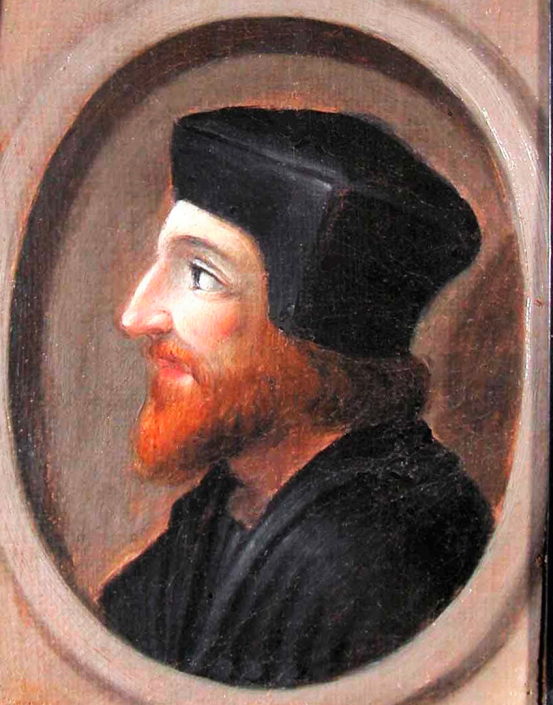
Sienese painter, Portrait of Agostino Chigi ‘Il Magnifico’, Ariccia, Palazzo Chigi
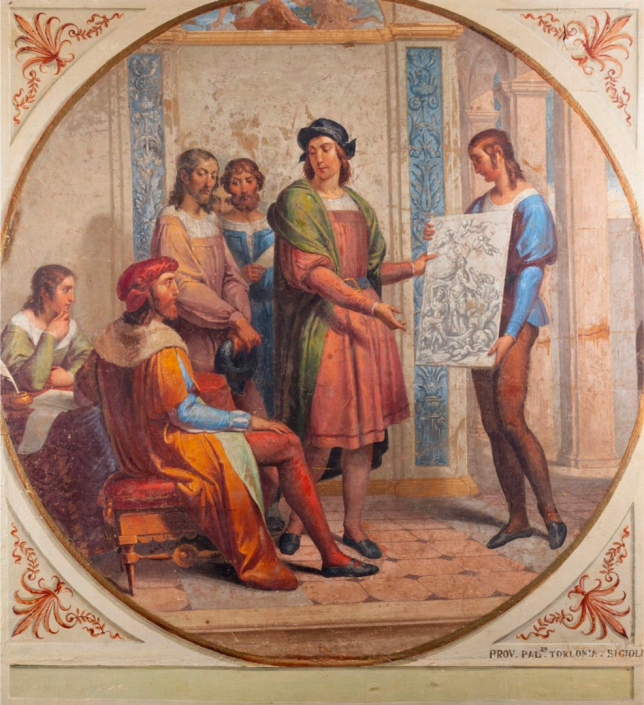
Filippo Bigioli, Raphael presenting the sketch of Galatea to Agostino Chigi,
1839, Rome, Palazzo Torlonia
Raffaello e Agostino Chigi
The Sienese banker Agostino Chigi, one of the richest and most influential men of his time, was, along with Pope Julius II della Rovere, one of Raphael’s greatest patrons.
Having settled in Rome, Chigi wanted to surround himself with the best artists to celebrate his prestige. As Pope Julius II’s banker, Agostino Chigi managed to have the divine master from Urbino working on the palace, with whom he established a relationship of mutual respect and collaboration.
Chigi’s patronage allowed the artist to express himself in contexts that were not strictly religious, also giving space to mythological themes. Through this partnership, Raphael further consolidated his fame and his ability to speak to a cultured and cosmopolitan audience, those who frequented the Villa di Chigi.
Raphael at Villa Farnesina
Villa Farnesina, Agostino Chigi’s suburban residence, is one of the places where Raphael’s art achieved extraordinary results. Here, the artist created the famous Triumph of Galatea, a fresco that combines compositional grace and classical inspiration.
The mythological scene, set in a seascape vibrant with movement, expresses the ideal perfection of the human body and the balance of forms, central themes of his poetics.
In the same villa, Raphael also designed the decoration of the Loggia of Cupid and Psyche, entrusted largely to his collaborators but based on his drawings. These cycles celebrate not only ancient mythology, but also the power and refinement of the patron.
Raphael’s intervention helped to make the Chigi residence a symbolic place, where art, myth and social life intertwined harmoniously.