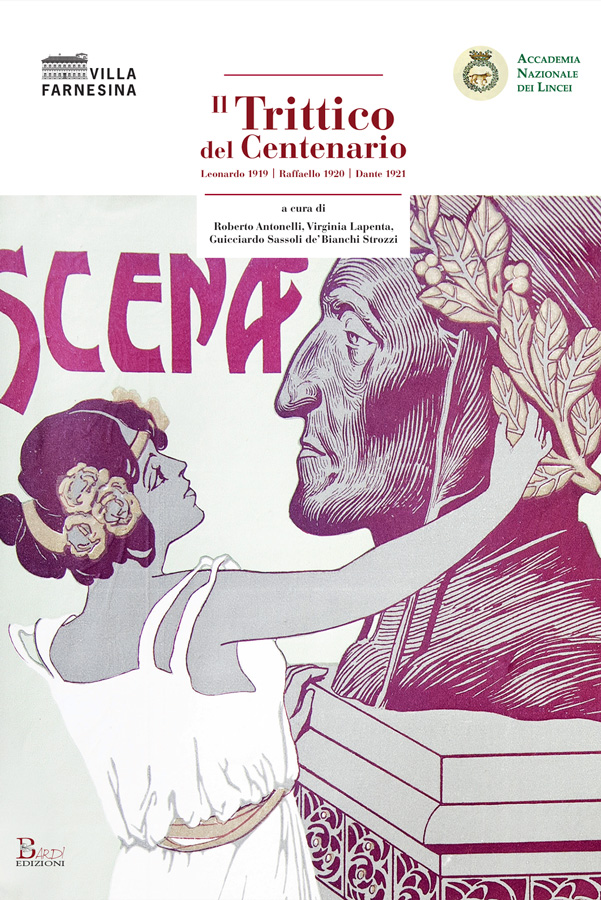
Curated by: Roberto Antonelli, Virginia Lapenta, Guicciardo Sassoli de’ Bianchi Strozzi
Il Trittico del Centenario | Leonardo 1919 | Raffaello 1920 | Dante 1921
Description
The exhibition The Centenary Triptych: Leonardo 1919, Raphael 1920, Dante 1921 (Rome, Villa Farnesina, June 16, 2021 – January 13, 2022) presents a survey of the taste and aesthetics that shaped the post–World War I celebrations of the centenaries of Leonardo (1919), Raphael (1920), and Dante (1921).
These were years in which the country, emerging from the Great War, needed to rebuild its national identity by invoking a glorious past—not only of beauty, but also of intellect and moral integrity—while at the same time looking toward the future with a spirit of innovation and change.
The celebrations were therefore not merely an opportunity, as they are today, to deepen studies and research, but rather a source of inspiration for both avant-garde and traditional artists. They engaged every sphere of human creativity, reaching the entire population through postcards, objects, furniture, architecture, and magazine and newspaper covers, paving the way for new styles and trends that absorbed and reinterpreted the legacy of the great masters being commemorated.
The exhibition, set up on the first floor of the Villa Farnesina, was divided into three sections. Alongside period magazines, objects, and books, it featured works by leading figures of twentieth-century art (from private collections) such as Carlo Carrà, Giorgio de Chirico, Gino Severini, Mario Sironi, Anselmo Bucci, Achille Funi, Adolfo Wildt, Alberto Martini, Gerardo Dottori, Plinio Nomellini, Cesare Monti, Ottone Rosai, and Lucio Fontana, as well as a series of postcards designed by Ezio Anichini for the Dante centenary of 1921.
A separate section, located in the Sala Massari, was dedicated to the revival of ancient Roman and Renaissance models in modern architecture of the 1920s, as well as in Mario Sironi’s designs for the “Urban Peripheries.” Also on display were drawings for magazines designed by Fortunato Depero, Gino Severini, and Marcello Nizzoli—true proto-designers who anticipated, through their graphic work, the advertising language and the distinctive “Italian style” or Made in Italy that would flourish in the 1950s and 1960s.