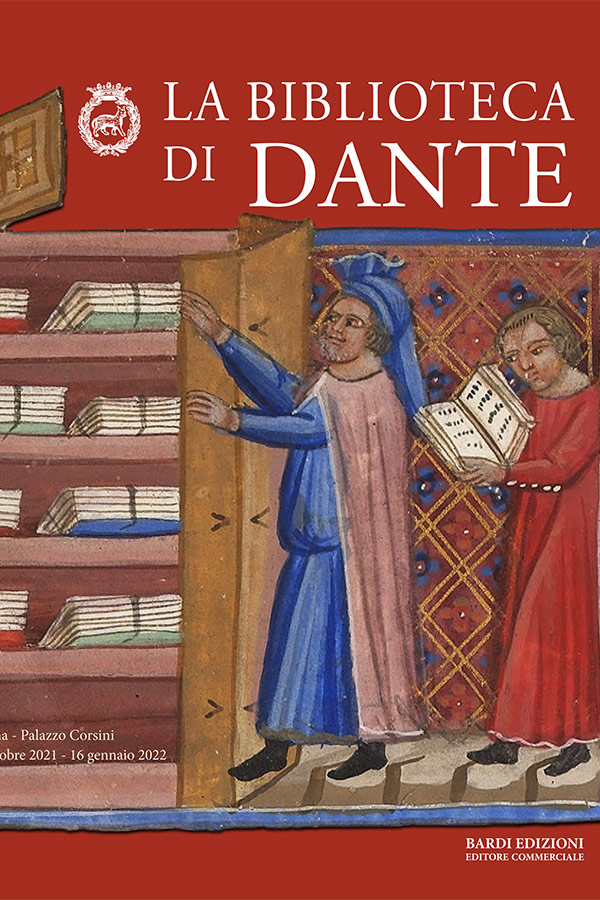
Authors: Roberto Antonelli, Lorenzo Mainini
Dante’s Library
Description
In Dante’s works, and in the Commedia in particular, the traditions of classical, Christian, medieval, and Romance culture are brought together as in a summa: authors, books, schools of poets and philosophers, encyclopedias, ancient mythologies and Christian dogmas, canonical writers and more eccentric figures are all reinterpreted through Dante’s gaze. While composing his own texts, the poet simultaneously rewrites the very tradition to which he belongs.
In this sense, understanding which readings and which books materially nourished Alighieri’s culture and poetic imagination has always been a crucial question for both critics and readers. The issue of Dante’s “library” is one facet of the broader inquiry into “Dantean memory”: a system of correspondences and figures, of echoes and allusions to other texts, that permeates the structure of all of Dante’s works and, in the Commedia, becomes the organizing principle of words and images — as memoria rerum and memoria verborum — a key factor in deepening and elevating the poetic language.
The reconstruction of this extraordinary system of memories—and of its texts—runs up against the fact that Dante did not possess a true, stable, and personal library, as would later be the case with Petrarch. The debate over which works Dante actually read and which he knew only through others’ quotations or epitomes therefore remains open and highly significant.
The catalogue predominantly features manuscripts from the 13th and 14th centuries—books whose physical form corresponds to the kinds of codices Dante himself might have read and leafed through.
The structure and contents of the catalogue are organized into six thematic sections reflecting the major currents of Dante’s “library”: the Bible and the Christian tradition; the auctores in the Vita nuova; the Romance tradition; the auctores after the Vita nuova; medieval rhetoric and treatises; philosophy, science, and theology.