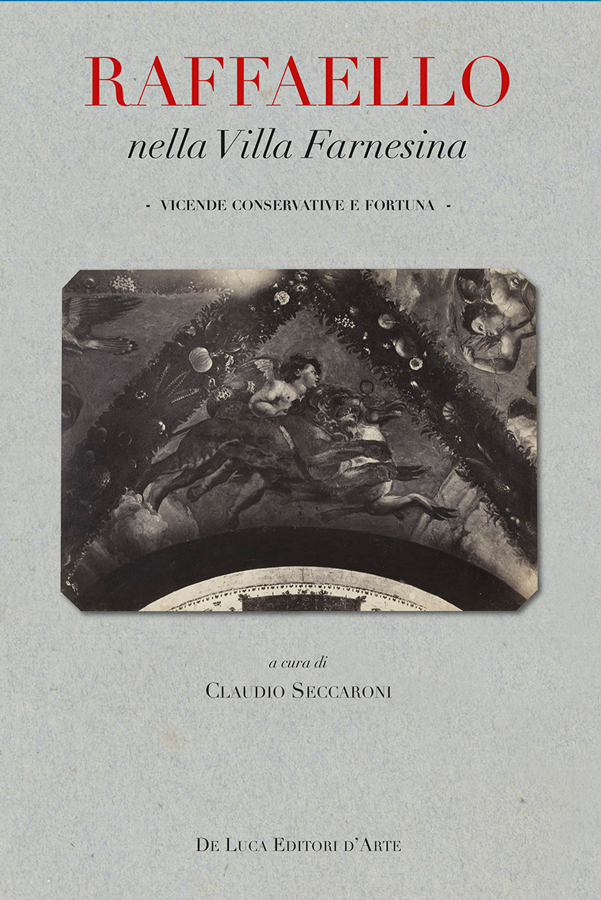
curated by Claudio Seccaroni
Raphael in the Villa Farnesina: Conservation History and Legacy
Description
The Villa Farnesina houses Raphael’s most celebrated secular compositions: The Triumph of Galatea and the Stories of Cupid and Psyche. As early as the sixteenth century, precisely because of these paintings, the villa became a regular destination for art lovers and artists, who studied, cited, and reinterpreted them.
Thanks to graphic and pictorial records, travelers’ descriptions, Bellori’s famous account of the restoration carried out by Carlo Maratta, and the subsequent controversies it provoked, it is possible to trace the conservation history of these paintings over time.
From the mid-nineteenth century onward, with the advent of photography, visual documentation of these works increased significantly. The large body of material that has emerged shows that, even in the pioneering days of photography in Rome, these paintings were repeatedly photographed. During this period, photography and engraving competed as means of documenting artworks—particularly wall paintings—although engraving continued to be preferred for some time, as it was considered more faithful in reproducing tonal relationships among the various color areas.
In these decades, however, the use of photography often became inseparably intertwined with engraving, effectively serving as a powerful complement for a fuller understanding of the translated work. In the case of the documentation related to the Loggia of Cupid and Psyche, materials preserved in the collections of the Royal Chalcography—now held at the Istituto Centrale per la Grafica—have made it possible to highlight how some of the earliest photographic series devoted to the frescoes were used precisely as aids in the production of an engraved series of these paintings.