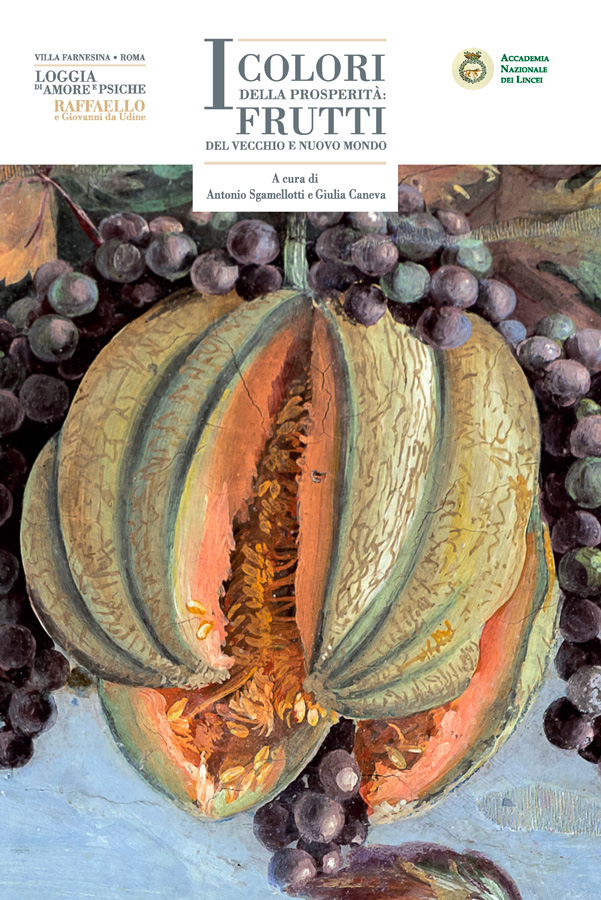
Authros: Caneva Giulia e Sgamellotti Antonio
The Colors of Prosperity: Fruits of the Old and New World
Description
The Villa Farnesina was built at the behest of the wealthy Sienese banker Agostino Chigi. Designed by Baldassarre Peruzzi and frescoed by artists of the caliber of Raphael, Sebastiano del Piombo, Sodoma, and Peruzzi himself, it stands as one of the highest expressions of the Italian Renaissance.
Since 1948, the Villa Farnesina, together with its magnificent garden, has been entrusted to the National Academy of the Lincei, which uses it as its prestigious representative headquarters.
The vault of the main loggia was frescoed according to a design by Raphael, drawing inspiration from the tale of Cupid and Psyche taken from The Golden Ass by Lucius Apuleius (1st century AD). It was adorned with naturalistic motifs executed with extraordinary mastery by Giovanni da Udine, who sought to create a visual link between the interior spaces and the surrounding garden.
The varied arrangement and richness of the plant species—around one hundred and seventy botanical entities—demonstrate the painter’s unique stylistic language and remarkable use of color. Particularly exceptional is the inclusion of rare and exotic species from all the continents then known, with a notable presence of American plants depicted barely twenty years after the discovery of the New World.
The uniqueness of the Loggia was celebrated in the exhibition “The Colors of Prosperity: Fruits of the Old and New World”, held at the Villa Farnesina from April 20 to July 20, 2017. The exhibition was curated by Antonio Sgamellotti (Professor Emeritus of Inorganic Chemistry, University of Perugia) and Giulia Caneva (Professor of Environmental and Applied Botany, Roma Tre University), who had previously authored a monograph on the flora depicted in the Loggia.
The exhibition complemented the variety of iconography and its associated symbolism with the results of an in-situ campaign of non-invasive XRF, IR, and IRFC imaging analyses, aimed at characterizing the materials and execution techniques. Thanks to recent technological advances in spectroscopic imaging, these studies expanded upon those conducted during the last restoration by the ISCR (Istituto Superiore per la Conservazione e il Restauro) in the 1990s, shedding new light on this precious Raphael workshop and revealing previously unknown aspects.
The exhibition unfolded through the once-private rooms of the magnificent residence and was complemented by an introductory video room dedicated to the Villa Farnesina gardens—of which the garlands in the Loggia provide an interior illusion—and by a room displaying several sixteenth-century editions from the Library of the National Academy of the Lincei and Corsiniana, illustrating the artistic and scientific context in which the decorative masterpiece of the Loggia of Cupid and Psyche was conceived.