
A journey through history, art and nature in the gardens and outdoor spaces of Villa Farnesina.
Walking through the avenues and buildings surrounding Villa Farnesina means taking a journey through different eras and atmospheres: from ancient Roman walls to secret Renaissance gardens, from botanical collections to contemporary artworks, from historic architecture to archaeological artifacts.
Each stop holds stories of illustrious figures, urban transformations and memories that interweave the life of the Villa with that of Rome.
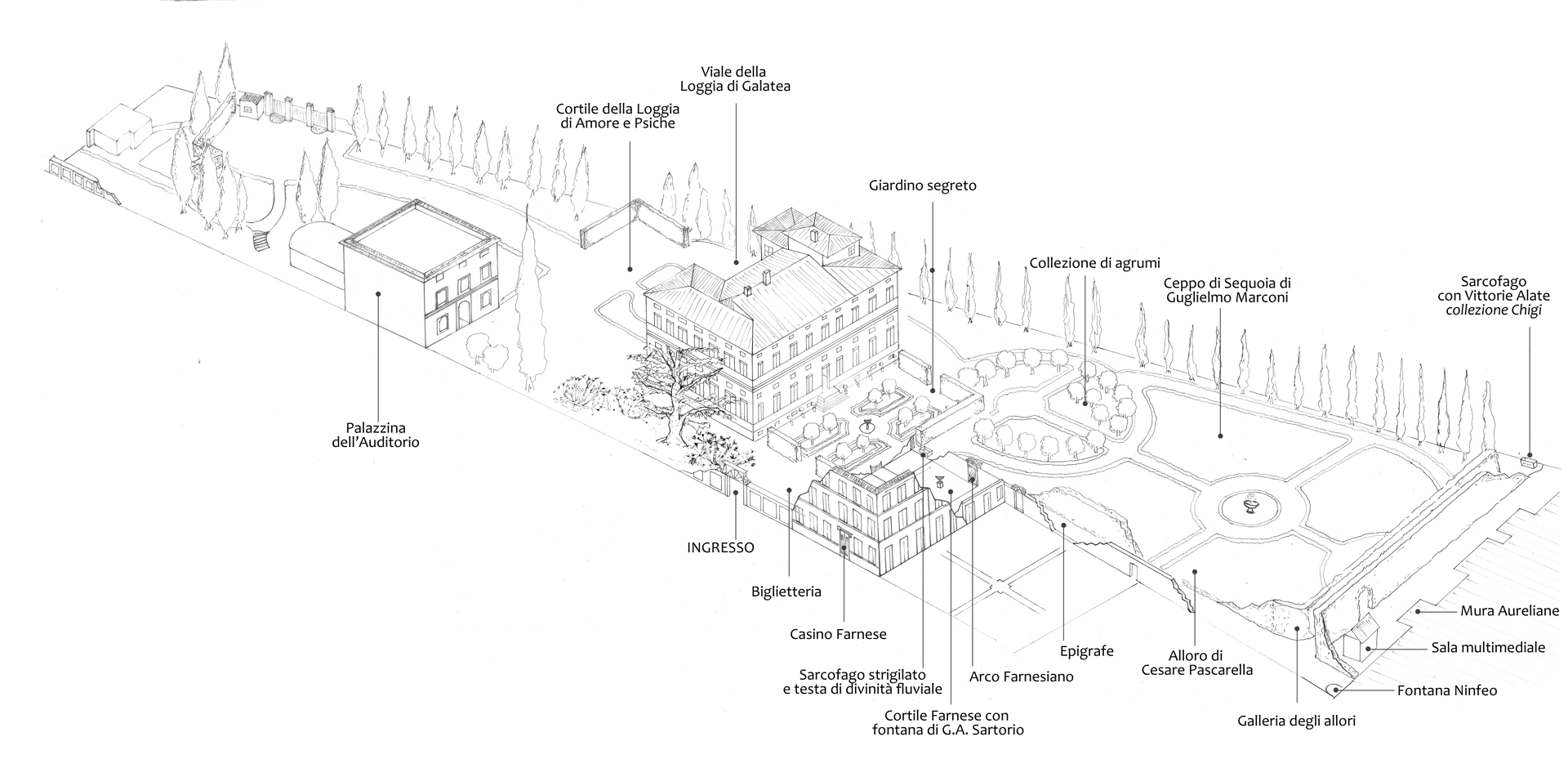
Auditorium Building
The Auditorium Building, spread over three floors, is used for offices and conferences by the Accademia Nazionale dei Lincei.
The building, dating back to the 19th century, was originally dedicated to the charitable work of Queen Margherita of Savoy, providing shelter for single mothers. In the 1930s, it was converted to house the Library of the Royal Academy of Italy, which at that time established its representative headquarters in Villa Farnesina.
The renovation project, designed by engineer Giovanni Massari in 1933, involved replacing the floors, creating a storage area for over 50,000 volumes, meeting rooms, offices and a large conference room. At the suggestion of architects Cesare Bazzani and Marcello Piacentini, an apse was added to the north side of the building, transforming the rectangular hall into an auditorium with approximately 250 seats. Hence the name “Palazzina dell’Auditorio” (Auditorium Building). To facilitate access for scholars, an underground connection to the Villa was also built.
The building perpetuates the ancient stables of Agostino Chigi commissioned to Raphael the architect, known only through drawings and structured in three naves with a staircase at the rear. All that remains of this construction are the plinth, the pedestals, the bases of the pilasters and part of the walls, once used as stables.
Courtyard of the Loggia of Cupid and Psyche
The Villa Farnesina was perfectly suited to accommodate gardens – so much so that in the 16th century it was called the “Palace of Gardens” – also from an architectural point of view, with the two projecting wings that define the north façade and frame the Loggia of Cupid and Psyche.
Here, on the vault frescoed in 1518 by Giovanni da Udine, pupil of Raphael Sanzio, 170 species of fruits and flowers are recognized, symbols of prosperity and love, conceived as a continuum with the exterior, rich in botanical varieties that came from the Mediterranean and from then exotic lands, even from the New World, testifying to the vast resources and relationships of the banker Agostino Chigi.
The small courtyard of the Loggia, enclosed by walls, had the characteristics of the secret garden, like the other in the opposite section, at the south entrance of the villa. The two secret gardens, called Horti conclusi, inspired by the ancient Roman vignae and monastery cloisters, intimate refuges in nature and silence according to the ideal of the locus amoenus, were created between 1506 and 1511.
This courtyard, with a central fountain (not original), was fed by an ingenious water system that exploited the water of the Tiber, the result of the mastery of engineers working together with architect Baldassarre Peruzzi. The space had been conceived as a “theater of greenery” for staging theatrical performances, a “container” in which to position scenography facing the palace which thus became the stage and backdrop of the performances.
Citrus Collection
Citrus fruits have always constituted the main arboreal wealth of the viridarium and their presence has remained constant over the centuries. Still at the end of the nineteenth century, Pierre Fremont, protagonist of the novel Rome by French writer Émile Zola, recounts that in the garden of the Farnesina, even if “abandoned […] devastated, bent, invaded by weeds […] the golden fruits of oranges and cedars always ripened“.
Among the citrus trees visible today, the giant citron (Citrus medica maxima) stands out, a vigorous plant with an upright habit and an irregular, spiny canopy. It has smaller leaves, elliptic-oblong in shape, with a rounded apex. It is highly productive and ever-flowering, with its main blooms occurring in spring and autumn. It bears large, fragrant white flowers arranged in clusters. The fruits are very large, corrugated, and oblong-pyriform in shape. The skin is very thick and yellow in color.
An ornamental variant of citron that can be admired in the Villa’s garden is the so-called “Buddha’s hand” (Citrus medica digitata) which produces fruits with “fingers.”
Other rare species include the ribbed bitter orange, the Sweet Lime of Rome, the Mellarosa lemon, the Adam’s Apple, and the Florentine Citron.
Farnese Casino
Before the death of its rightful owner, and before it was purchased by Cardinal Alessandro Farnese in 1579, Villa Farnesina bordered a property of the Farnese family on its south-eastern side. This property had been established in the final years of the fifteenth century, at the expense and by the will of the then Cardinal Alessandro Farnese the Elder, grandfather of the Alessandro Farnese who would later purchase the Villa, and the future Pope Paul III. He found this place very pleasant, thanks to its healthy environment and close contact with nature, and he was accustomed to visiting it daily, even after his ascent to the papal throne, in order to relax and recover from his daily duties.
The property primarily included the building facing Via della Lungara, the so-called Casino Farnese, now the ticket office and guest house of the Accademia dei Lincei, which underwent significant modifications in the second half of the nineteenth century. It was a spacious residence, without a loggia or belvedere, featuring architraves and openings distributed in a not entirely symmetrical manner.
Behind the Casino opened a courtyard, called the cypress courtyard for the tree planted there by the cardinal on the occasion of his graduation. At the center of the courtyard stood, and is still visible today, a wall fountain surmounted by the Farnese lily. There were also a walled garden adjacent to the cypress courtyard, and a large garden at the back, towards the Tiber, bounded by the city walls.
Strigillated Sarcophagus
Facing the first clearing of the path surrounded by citrus trees, there is a fountain created at an unknown time by combining two different archaeological artifacts.
A large sarcophagus has been repurposed as the basin, belonging to the type known as strigillated sarcophagi, a term derived from the type of fluted decoration arranged symmetrically on the front, whose wavy pattern recalls the “strigil,” the curved instrument ancient athletes used to cleanse themselves. The front of the sarcophagus is enclosed within an elegant frame (kymation) with ovules and astragals, topped with a pattern of wide trilobed leaves and bordered laterally and below by a braided motif. These decorative elements suggest the sarcophagus dates between the late 3rd and early 4th century AD.
The colossal head used as a water spout above the sarcophagus was adapted for this function through the loss of its nose and part of its lips.
The sculpture, documented in the context of the Chigi-Farnese properties since the 17th century, depicts a marine Triton, as revealed by the seaweed crossing the surface of the face. The wavy hair, which descends to cover the neck with short curls, is worked to give the hair a wet effect.
Secret Garden
On the south side of Villa Farnesina was one of the two “secret gardens” that once surrounded the building.
Enclosed by walls, this rectangular space extended to the nearby Casino Farnese, now the Villa’s ticket office and guest house of the Accademia dei Lincei. The garden was divided into geometric flowerbeds, adorned with flower pergolas and fruits, with a central fountain, whose remains are still visible today.
The current appearance of this space is due to a renovation and conservation intervention promoted by the National Academy of Lincei in the early 2000s, aimed at restoring the sixteenth-century spatiality of the secret garden through the placement of yew hedges, which were present in the sixteenth-century garden. The secret garden of Agostino Chigi also contained other species of trees and plants, as well as a rose garden with many varieties of roses.
Cesare Pascarella’s Laurel
The laurel (Laurus nobilis) is an ancient and renowned plant which, in the classical world, symbolised knowledge and glory. It was sacred to Apollo, the solar god and protector of the arts, music and poetry, who was said to wear a laurel wreath after Daphne was transformed into this plant. In the Temple of Apollo at Delphi, a priestess, intoxicated by laurel potions, delivered oracles that dispelled—though not always explicitly—doubts and uncertainties.
This laurel tree was planted by Cesare Pascarella, a dialect poet, writer, and painter, during the decade (1930-1940) when he was a member of the Royal Academy of Italy.
Sarcophagus with Winged Victories
The section of the Aurelian Walls present in Villa Farnesina’s park is one of the oldest remaining in Rome. Built in 271 AD by order of Emperor Aurelian with the aim of stopping the advance of Northern European populations towards the Roman Empire, the Aurelian Walls extended for 19 km and were up to 6.5 meters high.
This wall circuit connects directly with Porta Settimiana, which since medieval times opened onto the via sancta, later renamed Via Settimiana by Pope Julius II della Rovere, which connected Trastevere with the Vatican and St. Peter’s Basilica.
The state of preservation allows recognition of various construction phases, evidenced by different building techniques. The base belongs to a possibly eighteenth-century reinforcement intervention and consists of massive masonry of irregular tufa blocks alternating with few bricks and is bordered by a brick cornice. In the upper part, the curtain wall built under Emperor Honorius (by whose order around 403 AD the height of the walls was almost doubled) can be seen, above which some modern masonry repairs can be distinguished that might date back to the pontificate of Pius IX. The left tower, which is preserved in its full height, shows the remains of the protiro that connected the upper maneuvering chamber with the uncovered walkway. The right tower, in worse condition, was inhabited in the nineteenth century by one of Rome’s public washerwomen, who carried out her activity inside.
What can be observed today in Villa Farnesina’s gardens is a surviving section of the glorious walls that from 1876 were sectioned and removed to make way for the construction of Lungotevere della Farnesina, considered the first engineering intervention of national scope in the newly formed Kingdom of Italy.
Aurelian Walls
At the end of the path that branches off to the left of the avenue running along the boundary wall between the garden and the area of the current John Cabot University, there is a rectangular sarcophagus without its lid, on whose front are carved two winged Victories, with linear and synthetic features. Facing each other in mirror image toward the center, they support a “tabula ansata“, that is, a plaque with handles, dating to the 2nd century AD, which bears a Greek inscription with the name of the Greek freedman Marcus Aurelius Giocondo who was buried there.
The Victories are dressed in a tunic that covers the entire body, whose folds follow the movement and flow of air. The feathering of the wings is also rendered with remarkable realism. The faces, in profile, show a simple hairstyle formed by a “tenia”, a braided band that follows the forehead and is gathered in a chignon at the nape. The sarcophagus was probably part of Agostino Chigi’s collection of antiquities, as reported by some contemporary testimonies.
Guglielmo Marconi’s Sequoia Stump
A stump of California sequoia (Sequoia sempervirens) is what remains after the felling – in the 1980s, due to wood rot – of the specimen planted by Guglielmo Marconi during the seven-year period 1930-1937 (the year of his death) when he was President of the Royal Academy of Italy, which was then housed in Villa Farnesina. Marconi took great care of the Villa’s garden and its plants.
Nymphaeum Fountain
Continuing along the avenue that runs along the boundary wall between the garden and the area where John Cabot University is now located, there is positioned a sculpture representing a female figure, covered by drapery that falls only in the lower part of the body, captured in the gesture of supporting a half-open shell. Despite heavy restoration in the upper part, this is a work from the Roman period inspired by a well-known Hellenistic sculptural model: the so-called Aphrodite of Syracuse.
Compared to the original model, however, some significant variations have been introduced, such as the movement of the drapery and the shell basin that transform the goddess of love into a more prosaic sea nymph. The goddess is placed within a niche that imitates a natural grotto, framed by a stone mosaic.
The sculpture could be what remains of a more complex composition, with putti supporting vases as water spouts. In the mid-16th century this ensemble is described as part of the original decoration of the Farnese garden, before the acquisition of the Chigi property, in the famous description of Roman statues compiled in 1556 by the Bolognese naturalist Ulisse Aldrovandi.